UGC & Content Creation
Influencer Marketing
Social Media Management
Paid Advertising
Video Production & Editing
- Contact Us
- Get A Free Analysis
Summary:
This blog explains micro vs macro influencers in plain words. It covers how influencer tiers that Indian brands follow are usually split, how engagement changes with follower count, what each type does well, and how a small brand can choose. You will also find a hypothetical example, a few checks to run before you hire anyone, and some FAQs at the end.
For most small brands, microcreators are the safer place to start. They cost less, their audience is usually focused on one topic, and you can work with a few of them at the same time. Macro creators make more sense when you want a lot of people to see your brand quickly, and you have the budget for it.
Still, micro vs macro influencers is not a fight with one winner. It depends on your goal, your budget and how much testing you can handle, and the rest of this blog goes through each of those.
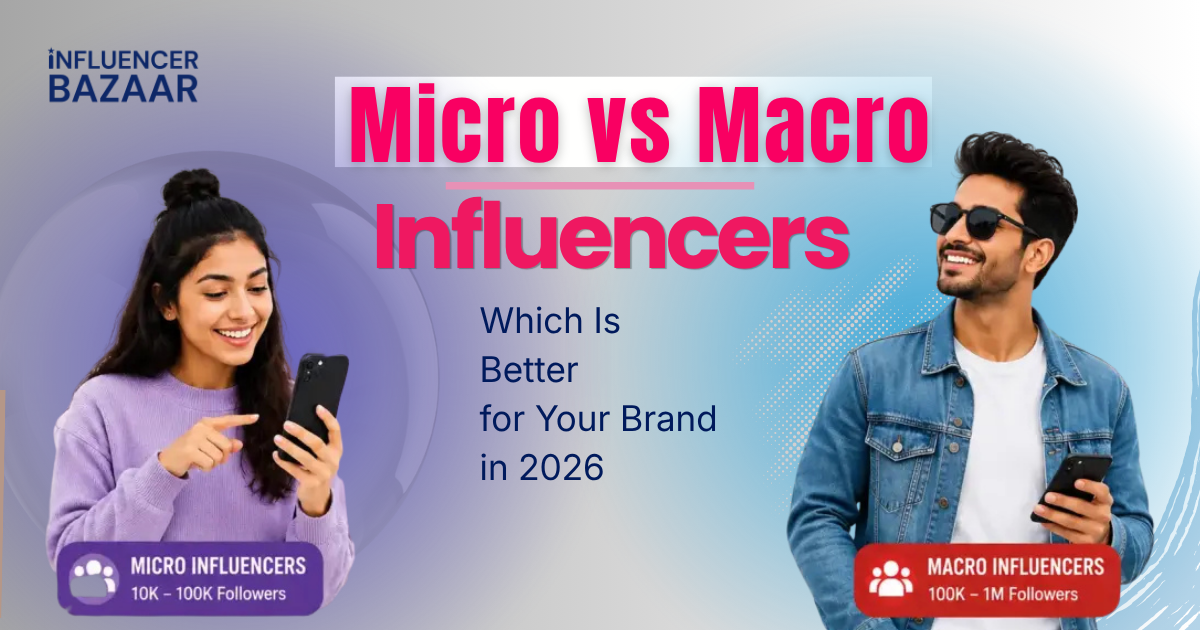
There is no official rule for follower ranges, and every agency and report draws the lines a little differently. Most 2026 guides use something close to this:
If you read two reports on influencer tiers India agencies publish, check where each one places the macro line. One may start it at 100K and another at 500K, so the numbers will not always match. A tier is also just a rough label. A creator with 90K followers and one with 110K followers are not very different, even though one is called ‘micro’ and the other ‘macro’.
At Influencer Bazaar, we work with nano, micro and macro creators, so we see brands mix tiers all the time. Most small brands do not have to pick only one.
Engagement rate is the share of followers who like, comment, share or save a post. As the follower count goes up, the rate usually comes down. The numbers below are rough 2026 market estimates for Instagram, and they change from one report to another:
Treat these as a guide and not a rule. Influencer engagement rate by follower size also depends on the niche, the content format and how real the audience is. A 40K creator in a tight niche can beat a 400K creator with a mixed audience, and you only find that out by looking at their recent posts.
Why can engagement rate alone mislead you?
A high rate looks great on paper, but it does not tell you who is engaging. A creator who runs giveaways all the time can show a strong rate while real buyers stay away. Read the comments instead. Real interest looks like questions about the product, people tagging friends and replies that sound like actual people. A pile of fire emojis and one-word comments tells you much less.
Reach matters too. Ask the creator for the average views on their last ten Reels, not just the best one. If a 50K creator regularly gets around 20K views, that is a healthy sign. If the number is far below that, the audience may be smaller or less active than the follower count suggests.
Micro influencer marketing works best when you want people to trust your product. Micro creators usually talk to a small, specific group, like first-time skincare buyers or food lovers in one city, and followers often reply to them directly. Their recommendation feels like advice from someone you know.
The bigger work falls on your side. Ten micro creators mean ten chats, ten approvals and ten posting dates, and a small team feels that quickly. Quality can also be uneven, so a clear brief helps a lot.
Macro influencer marketing is about reach. One post can put your brand in front of hundreds of thousands of people in a day, which helps with a launch or when you enter a new city. Macro creators also tend to have better production quality and more experience with brand deals.
The cost is higher, and the trust is a bit thinner. Followers know these creators post sponsored content often, and some reports show the share of fake or inactive followers rising as tiers go up. Macro influencer marketing also needs more money upfront, and a weak post is expensive to fix.
Here is the quick version, one factor at a time:
With a small budget, the choice between micro-influencers vs macro-influencers for small brands mostly comes down to risk. One macro post that does not work can eat most of your money. A group of micro creators spreads that risk, because a few weak posts get balanced by a few strong ones. Many 2026 marketer surveys also show that more than half of marketers plan to expand nano and micro tiers this year while keeping celebrity spend flat.
If you have no past influencer data, I would not start with macro. Test with micro first, see which content works, and then put more money behind what performs. When brands come to us at Influencer Bazaar, this is the kind of mix we help them work out.
Macro is not off limits for small brands. A launch date, a festival sale or a move into a new city can all justify one macro creator. Even then, one macro creator plus several micro creators often works better than a macro alone. The macro post brings people in, and the micro posts give them reasons to buy.
Brands are spending more on creators than before, and a good part of that money is moving toward nano and micro tiers. Brands also use creator posts as paid ads more often now, so the rights you agree on matter as much as the post itself. Ask early whether you can run the content as an ad and for how long, because that is much easier to settle before the work starts.
Instagram is where most creator budgets in India land, and short video does a lot of the work there. So look at how a creator does in Reels and not only in photos.
This is a made-up example, not a real client case. A small skincare brand has a monthly budget that could pay for either one macro creator or about eight micro creators. It goes with eight micro creators across different skin concerns. Three of them post content that gets saved and shared a lot, so the next month the brand puts more money into those three and adds one macro creator for a sale week.
The brand learned what works first and spent big later, which is the safer order for most small teams.
Neither side wins every time. Micro creators give you trust and room to test, and macro creators give you reach, and for micro vs macro influencers for small brands, starting with micro and adding macro later works well for most. If you want help picking the right mix, you can reach us at Influencer Bazaar.
Q1. What is the main difference between micro- and macro-influencers?
Micro creators have roughly 10K to 100K followers and usually get higher engagement from a focused audience. Macro creators have a much bigger following, so they give wider reach, but engagement is lower, and the price is higher.
Q2. Are micro influencers better than macro influencers for small brands?
For most small brands, yes, at least at the start. When you compare micro influencers vs macro influencers for small brands, micro creators cost less and let you test more than one voice. Macro creators can come in later when you want awareness.
Q3. What are the usual influencer tiers Indian brands follow?
Most guides use nano at 1K to 10K, micro at 10K to 100K, macro at 100K to 1M and mega above 1M. Some guides start macro at 500K, so always check how a report defines it.
Q4. What is a good engagement rate for micro creators?
Many 2026 reports put micro creators at around 2.5% to 4% on Instagram. Since engagement drops as accounts grow, compare a creator with others in the same tier and not with nano creators.
Q5. Is micro-influencer marketing cheaper than macro-influencer marketing?
Per creator, yes. Micro influencer marketing usually costs less per post, but your total spend depends on how many creators you hire, the content rights and how long the campaign runs. Macro influencer marketing costs more per post, so a single deal can take a big share of a small budget.
Q6. Can I use micro and macro creators in the same campaign?
Yes, and many brands do. A macro creator brings reach and recall, while a group of micro creators brings engagement, conversions and more content.
Q7. How do I check if a creator’s followers are real?
Read the comments for real conversation, look for sudden jumps in follower count and check where the audience lives. You can also ask the creator for a screenshot of their audience insights from the platform.
